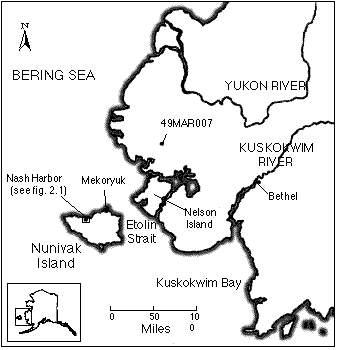
Figure 1.1, Lower Yukon-Kuskokwim Delta region. After Nowak, 1982.
Because of its low potential for commercially-exploitable minerals, Nunivak Island has attracted little geological exploration (Hartman and Johnson 1978). Ganopole (1972) summarized the surficial geology of the island. Unlike the nearby Yukon-Kuskokwim delta, which consists of late Tertiary and Quaternary sediments, Quaternary volcanic rocks form the entire surface of the island. Much of the present-day tundra has developed directly on basaltic lava flows. Ganopole also noted polygonal columns in the sea cliffs. The low mountains on the island are the cinder cones of dormant or extinct volcanoes. A small deposit of Cretaceous sandstone bearing non commerical grade coal surrounds Dahtkit Cove, on the northern shore of the island, east of Nash Harbor.
Many of the terrestrial fauna depend directly on marine resources; Nunivak boasts a dense population of migratory sea-birds, especially on the steep cliffs forming the northwestern corner of the island. A lack of predators other than foxes (Vulpes sp.) and minks and weasels (Mustelidae), coupled with the large nearshore fish populations make Nunivak a prime rookery for at least 89 bird species (Swarth 1934: 11 15). Cormorants (Phalacrocoracidae), puffins, auklets, and related birds (Alcidae), and gulls (Laridae) all roost seasonally on the cliffs of Nunivak Island. The inland tundra also supports migratory populations of loons (Gaviidae), grebes (Podicipedidae), and ducks and other waterfowl (Anatidae) (Hoffman 1990; Swarth 1934).
Arctic caribou (Rangifer arcticus) are the only large terrestrial mammals found in Nunivak archaeological sites, but they were rapidly exterminated in the 1880s by Cupiit and mainland Yupiit peoples armed with rifles (Lantis 1986:210). Americans introduced Greenland reindeer (Rangifer tarandus ) and musk oxen (Ovibos moschatus) to the island this century (Griffin 1996; Lantis 1946). A small population of wolves (Canis lupus) once lived on Nunivak Island, but was wiped out by the middle of the twentieth century (Griffin 1996). Small rodents (Cricetidae), shrews (Insectivora), foxes, and mustelids are the only small mammals (Lantis 1986: 209; Burt and Grossenheider 1976). Domestic dogs (Canis familiaris ) accompanied human settlers on the island (Lantis 1946).
Nowak (1982) apparently recovered a large faunal assemblage from the Mekoryuk sites, but this assemblage is poorly documented. He reported finding hair seal, bearded seal, sea lion, and beluga whale in large quantities at 49-NI-028. Chatters (1972) described a preponderance of caribou remains in one level from a single house pit at the Mekoryuk Village sites; he also reported large numbers of marsh birds' remains. Nowak and his crew found more than 1400 notched netsinkers of undocumented size and uncertain function. More than 1000 of these netsinkers appear in the Late Phase, although Nowak believed concentrations of netsinkers in the Late Phase represented caches rather than net remains, with the implication that the greater number of netsinkers in this phase may not have represented the increased use of nets. At any rate, the large netsinker assemblage suggested an increased reliance on mass fish-harvesting or seal-netting. Nowak's interpretation of the lack of change in the faunal assemblage from Norton to late historic times indicated to him that historic Nunivarrmiut have been living in much the same way for more than 2000 years.
Chatters (1972), in a brief report to Nowak, outlined the recovery of mammal and bird remains from several units at the Mekoryuk Village sites. Many of Chatters' results were difficult to interpret, since Chatters referred to the sites with their field designations. Without Nowak's field notes or Chatter's laboratory notes, I could ascertain to which sites and periods of occupation Chatters refers. Moreover, I had no information on conditions of excavation, such as screen size employed (if any). While most of Chatters' analyses appear to refer to Norton-era occupations that predate materials in my study, I will occasionally refer to his work when discussing the implications of faunal distributions at Nash Harbor.
Shaw (1983), in his work on the Yukon-Kuskokwim delta, reported netting technologies in assemblages associated with typologically late Norton check-stamped pottery. At 49-MAR-007 on the Manokinak River, Shaw (1983: 118 130, 245 252, 264 265) recovered a single net weight and the remains of a net, in addition to bone fishhooks, dart points, and wooden fishing implements, including a fish trap and fish clubs. Carved wooden artifacts representing cranes or ducks and a puffin bill decoration reflect a symbolic or ideological interest in birds (Shaw 1983: 156 161, 252, 360). Norton settlements on the delta were clustered at coastal localities with protected embayments, on headlands, or along rivers in the interior uplands (Shaw 1982: 70). Shaw (1982: 71; 1983: 359 360), and Shaw and Holmes (1982) characterized Norton hunting and fishing as "labor-intensive," relying mostly on large but infrequent takes of each major resource: fish (especially salmon), seals, and caribou. These three resources form the base of Bockstoce's (1973) "tripartite" economy. If Norton people could rely on at least two of the resources, they could remain well-fed and healthy. However, if more than one of the resources collapsed, the people faced hard times.
Researchers have published very little data on Thule occupations on Nunivak Island. Nowak (1988a) mentioned a potential Thule-era occupation (A. D. 1200) at the Mekoryuk River shell midden site 49-NI-030, and noted that he identified neither walrus nor beluga at the site, but that sea lions "appear in small numbers" (Nowak 1988b: 46). Nowak (1982) seems to have dismissed the possibility of substantial changes after about 2000 B.P. in Nunivarrmiut subsistence activities, based on his summary analysis of the faunal assemblage from the Mekoryuk Village site, 49-NI-028.
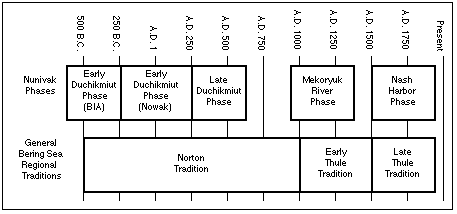
Data from elsewhere on the Alaskan Bering Sea coast can shed light on post-Norton subsistence patterns. The people of the Thule Tradition (after A.D. 1000) established the classic Arctic lifeway that continued until contact times. Evidence for early Thule occupations appears infrequently on the delta, although this is probably an artifact of the lack of archaeological investigation in the region. Shaw (1983) uncovered a late Norton component he terms the Yukon-Kuskokwim Phase (A. D. 400 1000) from 49-MAR-007, and a probable hiatus in occupation from A. D. 1300 to the recent past. The late appearance of net technology and bird remains at the site led Shaw to hypothesize that the people at the Manokinak River had adapted net technology for hunting waterfowl and small terrestrial mammals (Shaw 1982: 71 72). Ethnohistoric data from Nunivak (Hoffman 1990; Pratt 1990) also suggests that cliff-dwelling birds had become an important resource for Thule peoples. Avian resources added a fourth leg to Bockstoce's (1973) tripartite economy, making it generally more stable. By Thule times, Arctic hunters could operate solo or in small groups year-round, instead of relying on more labor-intensive and spatially and temporally restricted resource exploitation practices.
Section 2: Archaeology at Nash Harbor